
Strategy Decks to Strategic Action
One platform, many paths, a living strategy.
Strategy Schema
The Foundation
Transform your strategy into a structured, query-able framework. That schema becomes the foundation for everything: Employee activation, Leadership Alignment, Feedback and Iteration.
What you provide (some or all):
- Strategy documents, slide decks, transcripts
- URLs to your website and strategy documents
What You Do:
- Upload your documents and URLs
- Complete as much or as little as you choose of an in-depth, guided dialog
- Complete an AI-guided leadership interview
What we extract:
Strategic framework
- Vision, Mission, Core Values
- Strategic Priorities
- Trade-offs
- Decision-Making Principles
Add More Depth at Any Time
Advanced Dialogs:
- Competitive Positioning Matrix
- Jobs to be Done Analysis
- Multiple Scenarios Planning
- Long-term Vision Mapping
- Results Backtracking (Merlin method)
Strategy Activation
Thinking From Strategy, Not About It
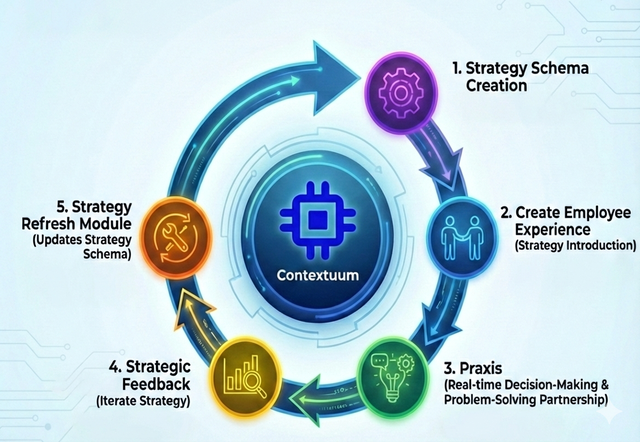
Strategy Activation transforms conceptual knowledge into muscle memory. Five integrated modules that activate strategic thinking across your entire organization.
Who Uses Strategy Activation
Everyone. The leadership team uses the same Praxis tools as the store manager. Scenarios adapt to role and context, but the strategic thinking capability is universal. This isn't training or teaching, it's activation.
For Leadership:
A dashboard provides visibility into completion, engagement, and usage patterns—helping you understand how Contextuum is being adopted across your organization without compromising individual privacy.
Strategy Introduction ✅ Required First
What it is: On-demand, AI-generated, role-specific introduction tailored to each person’s job.
What it does: Coaches people to “come from” the strategy through realistic scenarios. Employees must grapple with thorny situations they will likely encounter and choose the most strategic path. A store manager learns how “quality over speed” guides hiring decisions. A product manager practices choosing between features when both seem strategic. Each role gets situations that match their daily reality.
You’re assessed and scored on your strategic thinking—but not in binary right/wrong terms. If you face four choices, one might be most strategically aligned, while the others reflect degrees of alignment or misalignment. Your score reflects that nuance. It’s both gamified and analog. Kind of like life.
The shift: From “I know what the strategy says” to “I can judge what’s most strategic in my actual work.”
Time investment: 20-30 minutes. Required before accessing Praxis tools.


2. Decision-Making Module ✅
What it is: Structured thinking support for complex choices where the answer isn’t obvious.
What it does: Guides you through identifying core dilemmas, mapping consequences, and evaluating trade-offs specifically through YOUR strategic lens. Not generic decision frameworks—your organization’s strategic priorities applied to this specific situation.
When you use it: Facing a tough call between customer request and product roadmap. Choosing between two projects when budget only allows one. Any decision where there seems to be no “correct” choice.
The output: A well-reasoned, strategic decision.
3. Problem-Solving Module ✅
What it is: Systematic strategic problem-solving framework.
What it does: Helps you hone the essence of a problem, generate options, analyze second-order consequences, anticipate unintended outcomes and formulate probabilities and confidence levels to arrive at a solution. Applies your strategic framework to ensure solutions align with priorities.
When you use it: Customer complaints reveal a pattern. Operational friction suggests strategic misalignment. Any problem that’s more than just tactical—where the solution needs to be strategically sound or requires nuanced negotiation of competing priorities.
The output: Clear problem definition, evaluated options, high-confidence solutions.


4. Resolve Strategic Conflicts Coming Soon
What it is: Navigation tool for when strategic priorities collide in practice.
What it does: When “customer obsession” conflicts with “operational excellence,” or “innovation” conflicts with “predictable delivery,” this module uses your organization’s hierarchy of values to find the strategic path forward.
When you use it: Two strategic priorities both apply, but they point to different actions. Both matter, but you can only fully act on one.
The output: Strategic resolution that respects competing priorities while maintaining coherent direction.
5. Strategy AMA Coming Soon
What it is: Real-time strategic guidance system.
What it does: Ask any strategic question and engage with Contextuum’s AI—grounded in your strategy schema. Answer provocative questions, explore unasked questions, gain insights leading to clearer thinking.
When you use it: Strategic check before a meeting. Applying the strategy to an emerging situation. Testing whether an idea aligns with strategic direction.
The output: Socratic dialogue to hone your thinking and ensure it is strategically consistent.

Who Uses Strategy Activation
Everyone. The leadership team uses the same Praxis tools as the store manager. Scenarios adapt to role and context, but the strategic thinking capability is universal. This isn’t training or teaching, it’s activation.
Strategy Iteration
Keep Strategy Valid as Reality Unfolds
Strategy isn’t static. Markets shift, competitors arrive, new opportunities emerge. Strategy Iteration tools help leaders update the strategy without starting from scratch—and propagate those changes instantly across the entire platform.

Strategy Refresh & Iteration
“Keep Your Strategy Alive”
🔄 Team Strategy Review ✅ Available Guided facilitated sessions that walk your leadership team through key strategic decisions, surfacing where priorities have shifted or where clarity is needed.
👤 Individual Refresh ✅ Available
Solo version for individual leaders to review and reflect on strategic elements independently before group discussions.
💡 Strategic Calibration ✅ Available Compare your leadership team’s current thinking with the documented strategy to identify drift, evolution, or needed updates.
1. Strategy Refresh ✅
What it is: Re-experience your strategy creation process - the reasoning, trade-offs, and principles behind your strategic choices.
What it does: Walks participants through the strategic thinking that shaped your framework. Perfect for onboarding leaders who missed the original strategy session, or for you to revisit and refine your own strategic thinking as context evolves.
When you use it:
-
Bringing new leadership up to speed on strategic reasoning (not just conclusions)
-
Quarterly or annual strategic recalibration
-
Preparing Board presentations that show strategic thinking, not just outcomes
-
After major shifts (market, organization, competitive) that require strategic response
Available as: Team facilitation for collaborative exploration, or solo for individual reflection.
What happens after: Your updated schema (if you made changes) propagates automatically. Employee experiences reflect new priorities. Praxis tools incorporate updated framework.
Coming: Tailored versions for Boards and investors to experience your strategic narrative.
2. Collaborative Strategy Creation
What it is: Decentralized strategy development with structured feedback loops.
What it does: Enables strategy creation that incorporates diverse perspectives while maintaining coherent direction. The CEO drafts some or all of the initial strategy, key stakeholders (COO, CMO, CFO, department heads) provide structured feedback, leadership reviews and specific input based on their departmental or functional expertise.
When you use it:
-
Annual strategy development involving multiple leaders
-
Testing strategic direction before broader rollout
-
Building buy-in through structured inclusion
-
Capturing expertise distributed across leadership
The workflow:
-
CEO/owner drafts strategic framework in Contextuum
-
Stakeholders receive structured dialogs to review and add
-
System synthesizes input and defines differences
-
Leadership reviews, accepts, counters, or refines
-
Consensus emerges through iterative dialogue
The output: Strategy that reflects collective wisdom while avoiding "design by committee" dilution.
The Power of Renewal
When you update your strategy schema—whether through Refresh or Collaborative Creation—those changes flow through automatically. Employees don’t need retraining. Praxis tools don’t need reconfiguration. Your living strategy stays vital.
Strategic Intelligence
Capture Your Team’s Experience as an Early Warning System
Most CEOs learn their strategy is failing from quarterly results. By then, it’s crisis management. Strategic Intelligence captures signals while you can still course-correct—from your team’s frontline experience, the changing strategic environment, and leadership intuition.
What Strategic Intelligence Captures
From Your Team:
- Customer signals (pricing pressure, feature requests, competitive threats)
- Market shifts (new competitors, changing dynamics)
- Operational friction (where strategy meets reality)
- Strategic drift (where execution diverges from intent)
Privacy & psychological safety:
All employee input is anonymized and aggregated. Leadership sees patterns and themes, never individual usage. Praxis tools are safe spaces for honest strategic thinking—what you share stays private.
From Environmental Scanning:
- Relevant news and industry developments
- Competitive movements and market changes
- Technology shifts and regulatory updates
- Emerging opportunities and threats
From Leadership Observations:
Executives can add their own strategic observations—hunches, concerns, or emerging patterns they're sensing. Your Chief AI Officer notices a technological shift coming that could alter the product roadmap. Your COO senses operational constraints before they show up in metrics. Your CMO detects subtle changes in customer language. The AI considers these alongside other signals. The platform synthesizes all three sources—what your team is experiencing on the ground, what's happening in your strategic horizon, and what leadership is sensing.
How You Use It
Monthly Signal Check: Schedule regular reviews (monthly, quarterly, or on-demand). The system:
Aggregates employee signals from Strategy Activation usage
Scans relevant news, industry sources, and competitive intelligence
Incorporates executive observations and strategic hunches
Synthesizes patterns and surfaces what matters
Provides confidence ratings for each signal
Suggests possible implications for your strategy
You receive: A clear report showing what’s changing across all sources—weighted, synthesized, and analyzed in light of your strategic framework.
What it’s NOT: A complete SWOT analysis or strategy consulting replacement.
What it IS: One valuable input into your ongoing strategic thinking—combining frontline knowledge, environmental awareness, and leadership intuition before patterns become crises.

The Advantage
Know when your strategy needs attention three months before your dashboard shows it. Not through expensive consultants analyzing last quarter’s data, but through continuous signals from multiple sources—synthesized and assessed for strategic relevance.
Contextuum is Not Another Measurement Dashboard
You already have tools that track performance:
OKRs that measure achievement
KPIs that show progress
Dashboards that display results
Contextuum complements them by building strategic context:
Employees who understand “why” those goals
Teams who think about choices through the strategy
A living framework that adapts as reality unfolds
Think of it this way:
Your OKRs show where you’re aiming
Your KPIs show what you’ve done
Contextuum provides the compass for everyone to navigate moment by moment
Future: We’ll integrate WITH your existing tools to connect strategic context with performance da
Try It Yourself
Experience Contextuum For Yourself
Quick Start
Get a Working Experience in 30 Minutes
Answer 6 strategic questions about your organization. Then experience the learning platform as any employee role—see how your strategy becomes practical and personal. No commitment. No credit card. See if it resonates.
Simulation
Can You Succeed as a Strategic Employee?
Can you ace the role of a WeWork Real Estate Lead? A Zoom Product Manager? A Trader Joe's Crew Member? Learn each company's strategy, make decisions, and get scored on your strategic thinking. 12 roles across 4 companies. 5-10 minutes per role. See where you rank.